Which Crypto to Accept
A side-by-side look at fees, speed, and freeze risk for accepting crypto payments.
When paying for inexpensive goods and services priced at $2–5, a fee of several dollars can make the purchase pointless. For a business, three parameters matter: transfer cost, payment confirmation speed, and cost predictability.
Why Network Fees Matter for Micropayments
With micropayments, blockchain fees can become a significant business expense. The issue is not the cost of a single $2 or $5 transaction, but the cost of withdrawing hundreds of small payments.
Apirone uses a fully on-chain, non-custodial model. Each invoice has its own blockchain address, so funds from multiple micropayments remain distributed across separate addresses rather than being pooled into a shared wallet.
Developer Commentary
For micropayments, the choice of network affects both sides of the transaction. A low-cost network can reduce fees for the customer and the cost of withdrawing accumulated payments for the business.
This is especially important for tokens such as USDT on networks where processing funds from multiple addresses requires additional blockchain operations.
Fee Comparison
Figures below are as of early August 2026. Exchange rates change, but the approximate ratios should hold.
Bitcoin
Bitcoin remains the industry's primary payment asset. It's accepted by virtually every crypto service, and trust in the network is at its highest. That said, it isn't always a fit for micropayments: the fee depends on network load and can rise sharply during periods of high activity. In quiet periods it runs around 10 cents, but historically transactions have often gotten stuck for hours when the mempool backs up and fees spike.
Litecoin
Litecoin was built as a faster, cheaper counterpart to Bitcoin. Blocks land four times more often, and fees stay negligible even under heavy load. Despite lower popularity, LTC is still widely used specifically as a means of settlement. At Apirone it accounts for the lion's share of all transactions.
TRON
TRON could become one of the most in-demand blockchains for everyday payments, but unfortunately it isn't a popular one. Its native coin, TRX, settles almost instantly and costs very little.
Ethereum
Ethereum is the largest smart-contract ecosystem. After recent upgrades its fees are far lower than they were a few years ago, though they're still less predictable than Litecoin's or TRON's.Ethereum is the largest smart-contract ecosystem. After recent upgrades its fees are far lower than they were a few years ago, though they're still less predictable than Litecoin's or TRON's.
USDT and USDC
Stablecoins are convenient because they're essentially immune to price swings. For a merchant, that means no risk of revenue losing value within a few hours.
There is an important caveat, though: USDT and USDC are centralized tokens. Their issuers can freeze specific addresses at the request of regulators or law enforcement, and that can happen through no fault of your own. In some cases issuers have gone further than freezing — burning tokens outright, permanently removing them from circulation. For most legitimate companies this isn't an issue in practice, but the risk is fundamentally different from working with native cryptocurrencies.
These tokens also don't have their own blockchain, which means their transaction fee is tied directly to the network fee of whichever chain carries them. To withdraw funds on Tron, you pay a fee to activate each individual address, then a fee to consolidate all the payments onto one address, and finally the transfer to the recipient. For example: a client receives two payments — $20 and $15 — on two separate isolated addresses. Withdrawing that money means paying activation and consolidation separately for each address, and only then a single final transfer for the combined amount to the specified wallet.
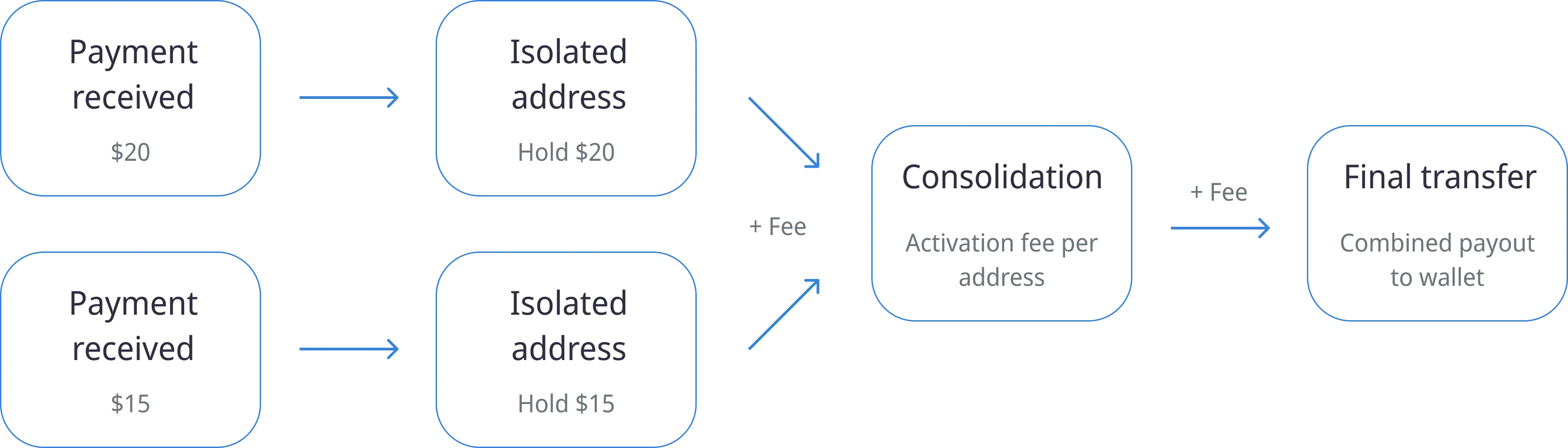
Of all the chains listed here, this is the most expensive and least efficient option — see our full breakdown of USDT network fees on Tron for the complete picture.
On Ethereum, the same operation costs an order of magnitude less. No address activation is needed, and the network fee itself is more than 10 times cheaper.
Gram (TON)
The TON ecosystem is growing fast thanks to its integration with Telegram. Transfers settle in seconds and fees are minimal, but payments in Gram aren't widely adopted, and its volatility (as with the former Ton) is too high relative to other currencies.
Bottom Line
If the goal is accepting small payments under $5, here's the optimal picture:
- 1.
Litecoin (LTC) — the best option among fully decentralized cryptocurrencies: low fees, fast confirmation, and no risk of frozen funds.
- 2.
TRX (TRON) and Ethereum (ETH) — near-instant, nearly free transfers. A good choice for services with high volumes of micropayments, provided customers are willing to use a volatile cryptocurrency rather than a stablecoin.
- 3.
USDT/USDC stablecoins on Ethereum — a fast, inexpensive way to receive payments with no volatility losses at all. But too expensive overhead costs.